

FOLKLIFE IN FOCUS – The Celebrated Tale Tellers of the Nevada Territory
Welcome to the Follow the Folklorist blog! Founded by Rebecca Snetlesaar and currently led by Nevada State Folklorist Brad McMullen, our blog is dedicated to exploring the rich tapestry of cultures, traditions, and celebrations that make Nevada such a vibrant state. Through our two main topics, Folklife in Focus and Notes from the Field, Brad will share his unique insights and experiences, providing a captivating glimpse into the diverse and fascinating world of Nevada folk traditions. Join us on this exciting journey as we delve into the stories, customs, and heritage that shape our state’s identity. Get ready to be inspired and amazed!
The Celebrated Tale Tellers of the Nevada Territory
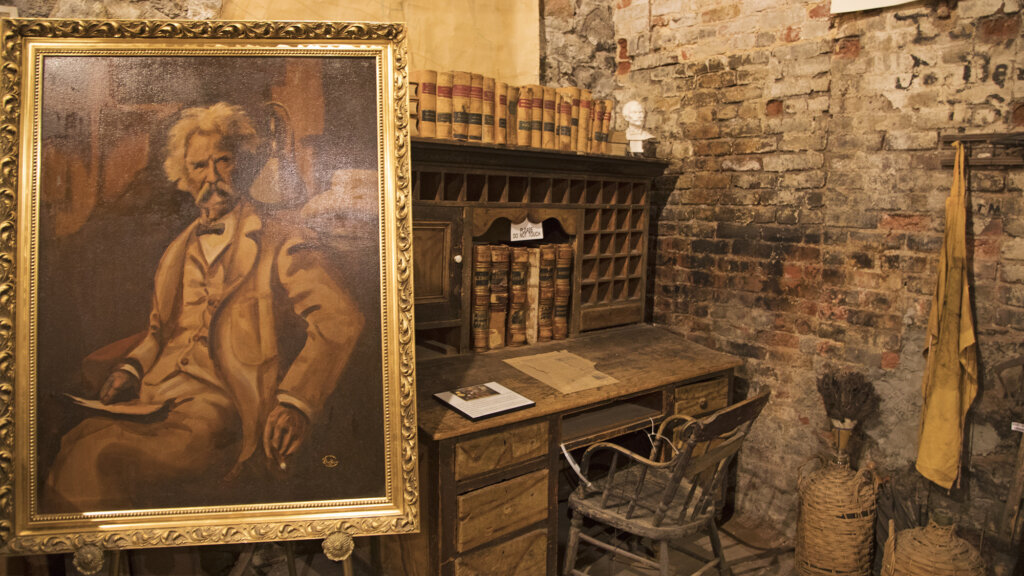
When we think of the early emigrants to the Nevada Territory, the people who come to mind tend to be the hard-working miners, ranchers, shepherds, and frontiersmen who made their living working the land. For every person who succeeded in making it rich off their work, many more failed and either left the territory or settled into some other career. One convenient alternative for any literate man was to take up the pen as a journalist, documenting the day-to-day goings-on of their slice of the territory. And once on the other side of the press, the wild yarns the miners, ranchers, and others told each night at the saloon made for good stories in both the local paper and those further afield. That’s the path Samuel Clemens took, after following his brother out to the Nevada Territory and taking up his more famous pen name, Mark Twain, after a failed career as a prospector led to success at the Territorial Enterprise. But Twain was far from alone on this path, with other Nevada miners-turned-journalists on the same path.
William Wright, better known by his pen name Dan DeQuille, is probably the best known of these other journalists. DeQuille was Twain’s compatriot at the Territorial Enterprise, as well as his editor and roommate. The two covered local stories together while also selling stories to other papers around the country. Less well known is Fred H. Hart, who left mining for writing over in Austin, serving as a journalist for the Reese River Reveille. Like Twain and DeQuille, he covered local stories about mining, but also the locals’ personal lives, including the tall tales they swapped with each other at the local saloon, the Sazerac. Hart compiled these tales in 1878 in his book The Sazerac Lying Club, where he claimed locals would gather and compete for the title of “Monumental Liar of America.” Other writers around the state and nation were collecting similar stories and publishing them, generating a large collection of what folklorists like me call tall tales.
Whether you call the story the truth or a gosh-darned lie, stories with exaggerated details are a staple of storytelling repertoires the world over. Tall tales are any kind of humorous story where the humor comes in the form of an exaggeration or a lie. Tall tales are presented as events that happened, whether to the teller or to a known figure. Still as the tale goes on, it becomes clear to people who know better that there is some chicanery afoot.
If you’ve ever heard (or told yourself) a story about the big fish that got away, that was a tall tale. When a child explains how someone broke in and ate the cookies, or a husband tells his wife about the implausible plumbing accident that resulted in the shirtless hunk in their bathroom, that was a tall tale. These familiar stories are the stuff of everyday life, the common excuses and exploits of the most outrageous person you know. But everyone tells one, now and again, as a way to save face after an unsuccessful adventure, to get out of trouble, or just to pass the time. The reasons and motives behind a tall tale are as varied as the people who tell them.
Out West, tall tales naturally thrived in casual conversations where they spread naturally, such as in a saloon or around a campfire after a day of wrangling cattle or prospecting. The tall tale was a way to explain why they came back empty-handed after a hunt, why that horse wasn’t broke yet, brag about a favored hunting dog, or wow bored friends with some spectacular sight up in the woods and mountains of the state. What writers like Twain, DeQuille, and Hart did was commit these oral stories to the page, recording them in a way that would last longer than a night spent drinking at the saloon. Compiling these stories in newspapers and books, they served not only as a way to celebrate local figures but also to publicize the exploits of Nevadans around the territory, country, and the world.
These efforts led to the perception of the tall tale as the quintessential American genre of folk tale, something we excel at in a way other countries can only aspire to. While the American claim to have perfected the tall tale may be overstated, it is true that the tall tale thrived on the frontier of the American West. With folk heroes like Paul Bunyan, Johnny Appleseed, and Pecos Bill spreading across the world and politicians like Davy Crockett and Abraham Lincoln using tall tales to build their reputations, the tall tale thrived around American fireplaces and in American writing.
And while the primary goal of any story is to entertain, tall tales serve another important role. They help delineate the important distinction between someone who knows something and a sucker. If someone believes the exaggerations, it’s not a tall tale; it’s just someone’s personal anecdote. And for someone who thinks the whole thing is fiction, it’s no different from a fairy tale. And so, the tall tale plays an important role in group formation, determining who is smart enough to differentiate lies from truth and appreciate the fiction. Because tall tales are dependent on the audience recognizing the exaggeration, they tend to occur in specific groups who will have the knowledge to recognize what is being presented in the tale. Understanding the story, laughing along with others, and replying with your own is a way to demonstrate that you belong in the group, that you know enough to be worthwhile talking to.
Exaggerated as they are, tall tales reflect the realities of the people who tell them, and Twain, DeQuille, and Hart were doing their job as journalists — reporting the news as their contemporary Nevadans lived it. While their neighbors and local audiences would be able to separate the truth from the exaggerations, just like how they separated valuable ore from the earth around it, the further away the audience was, the less they’d be able to know where exactly the story stopped being grounded in reality. While the frames and reputations of the author let the audience know that they were being told a joke, the exact details might elude them. There are even times when a known teller’s true stories were disbelieved based on their reputation alone. For example, Jim Bridger’s initial accounts of what is now Yellowstone National Park went unreported in newspapers because the stories were viewed as more of his tall tales.
Alternatively, for those with unknown reputations, the tales could be taken as true despite repeated disavowals. This happened to DeQuille with his story of the Travelling Stones of Pahranagat Valley. Published in the Territorial Expanse on Oct. 26, 1867, as a way to fill space on the paper on a slow news day, the story described round metallic stones that would move towards each other unless removed to a significant distance apart. The story took on a life of its own as it was reprinted in other newspapers around the world. DeQuille began to get inquiries from far and wide about the stones. While he would continue to encourage belief in the story through follow-up articles, he would privately let people know that the story was false. In one case, a group of German scientists wrote to learn more about these stones, and when DeQuille wrote back, informing them the story was a lie, they replied, cursing him for lying about it being a lie and saying he was depriving them of advancing science. Eventually, on Nov. 11, 1879, DeQuille would publicly admit the lie and discuss the various people who approached with ways to monetize the stones, including one carnival man who may have been famed fabulist P.T. Barnum.
While the traveling stones of Pahraganat Valley do not exist, the Pahraganat Valley does. Parts of it match the sterile description DeQuille provides. Still, the valley is best known for the natural springs, which make it a natural resting spot for people, migratory birds, and other animals. In the early days of the territory and the state, it was sparsely populated, like most of the southern part of the state. However, the reputation was still well known to Nevadans (if only from the time Gov. Henry G. Blasdel reappeared there after an extended disappearance in Death Valley). There’s no evidence of DeQuille’s fellow Nevadans ever bothering him about the stones, knowing that such things were fantasies made up by a bored journalist to fill page space. But for the suckers outside of the state? It matched their ideas of the West as a place of wonders and new discoveries that could change the world, and so they sought out stories to confirm those beliefs.
When writing their stories down, Twain, DeQuille, and Hart added their own flourishes and details, making the stories as much their own as the original tellers. But the core functions remained the same: to tell an entertaining tale and to separate the suckers from those in the know. Just as much as the miners and ranchers who surrounded them, these journalists helped forge the identity of Nevadans not just as hard workers, but as entertaining tale-tellers. And that’s remained a solid part of our identity even as time has marched on. Just as in the territorial days, most Nevadans are immigrants who left their homes in pursuit of opportunities here. Regardless of whether we hit the jackpot or not, we’ve all got some good stories to share, especially when we throw in a few harmless exaggerations. And while a famous marketing slogan might tell people to keep their exploits secret, stories about Nevada have proliferated in the modern era, just like they did in the 19th century. The legacy of Mark Twain and his contemporaries live on in each of us, so get out there and start spreading some tall tales. It’s your responsibility as a Nevadan!
You can share those stories with us as part of Our Nevada Stories – I can’t wait to hear them!
Visit the Nevada Folklife Archives on Flickr
Folklorists working for the Nevada Arts Council have been documenting folklife and folk arts in Nevada since 1986. After completing an ambitious 10-year project to digitize 22,823 color slides recorded between 1986 and 2005.
We’ve begun to share these images in photo albums on the Nevada Folklife Archives’ Flickr page, along with more recent photography completed over the past 15 years.
Are you conducting a project and looking for photographs? We’ll happily check the archives and post new albums for your viewing pleasure.